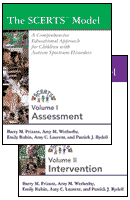
The SCERTS® Model
(Prizant, Wetherby, Rubin & Laurent, 2007)
What is SCERTS?
SCERTS® is developmental, relationship-based framework for working with autistic and neurodivergent children, their families and their educational team members. Specific guidelines for helping a child advocate for their needs and preferences while ensuring that all of the learners’ interactive partners reflect on how their support and the environment can be adapted to meet the needs of the learner and enhance active engagement.
The acronym “SCERTS” refers to the focus on:
“SC” – Social Communication – the development of spontaneous, functional communication, emotional expression, and secure and trusting relationships with children and adults;
“ER” – Emotional Regulation – the development of the capacity to maintain a well-regulated emotional state to cope with everyday stress, and to be available for learning and interacting;
“TS” – Transactional Support – the development and implementation of supports to help partners respond to the child’s needs and interests, modify and adapt the environment, and provide tools to enhance learning (e.g., picture communication, written schedules, and sensory supports). Specific plans are also developed to provide educational and emotional support to families, and to foster teamwork among professionals.
Who developed SCERTS?
The SCERTS Model collaborators include the team of Barry Prizant, Amy Wetherby, Emily Rubin, and Amy Laurent, who have training in Speech-Language Pathology, Special Education, Developmental Psychology, Occupational Therapy and Family-Centered Practice. The SCERTS Collaborators have more than 100 years experience in university, hospital, clinical and educational settings, are actively involved in clinical work, research, and educational consultation. The collaborators have published extensively in scholarly journals and volumes on ASD and related disabilities. A comprehensive two-volume manual provides detailed guidance for assessment and intervention efforts (Prizant, Wetherby, Rubin, Laurent, & Rydell, 2006).
Comments from Parents and Professionals:
“I love SCERTS! It makes sense to me and fits our family’s lifestyle. It is a results oriented program. Our family enjoys watching our child accomplish SCERTS objectives on his way to becoming a successful communicator. It is relieving to know that we are focusing on what will best help him on this journey by using the SCERTS grids and transactional supports.”
Sheri, parent of a 5 year old with ASD.
Where can I find out more about SCERTS and the SCERTS Manual?
For further information, including published articles on SCERTS and a detailed list of FAQ’s , click here: www.SCERTS.com.
For a listing of research supporting the SCERTS model, click here:www.SCERTS.com/research_corner.htm
For further information about the SCERTS manuals, email us at store@commxroads.com
Prizant, B., Wetherby, A., Rubin, E., Laurent, A., & Rydell, P. (2006). The SCERTS Model: A Comprehensive Educational Approach for Children with Autism. Baltimore, MD: Paul H. Brookes Publishing.
 Relationships and Social Connections are the Fuel for Learning!